Understanding Sequencing Risk: Protecting Your Retirement Savings

Market performance is unpredictable, and as you approach retirement, these fluctuations can have significant consequences. Careful planning and sound financial advice are essential during this critical period.

What Is Sequencing Risk?

The “retirement risk zone” refers to the 5-10 years around retirement when savings are most vulnerable to market downturns. Unlike younger investors, retirees may face compounding losses from early negative returns while drawing down their savings, known as sequence of returns risk.

How Sequencing Risk Impacts Retirement

For example, if you retire with $1 million and withdraw $40,000 annually, an initial 15% market drop followed by gains of 5%, 10%, and 20% over the next three years can still deplete your savings faster. Conversely, retiring in a bull market can offset withdrawals, preserving your balance.

Continue reading “Understanding Sequencing Risk: Protecting Your Retirement Savings”

Planning for a Comfortable Retirement: A Simple Guide

Retirement marks a significant milestone in life—an eagerly anticipated period where we can finally unwind, pursue our passions, and cherish moments with loved ones. However, the journey to a comfortable retirement requires careful planning and consideration. Here are some steps you can take to ensure financial security in your golden years.

At the heart of any retirement plan lies a crucial question: How much do you need?

Continue reading

2024-25 Federal Budget Update

Labor’s third Budget, unveiled on May 14, prioritised alleviating the cost of living for Australians. Treasurer Jim Chalmers emphasised its responsibility in balancing household support with economic stability. Key highlights include:

Tax Cuts:

  • Stage 3 tax cuts, effective 1 July 2024, will provide all tax payers with tax savings.
  • The savings range from $354 for those earning $30,000 to $4,529 for incomes exceeding $190,000.
Continue reading

Rebuilding Your Financial Foundation: Navigating Finances After Divorce

Divorce is a challenging journey, emotionally and financially. As you navigate through the upheaval of separation, one of the most critical aspects to address is your financial well-being. Rebuilding your financial foundation after divorce requires careful planning, organization, and a commitment to securing your future stability. Let’s explore some key steps and strategies to help you regain control of your finances post-divorce, drawing insights from expert advice.

Continue reading “Rebuilding Your Financial Foundation: Navigating Finances After Divorce”

How to create a budget

If you are trying to manage your cashflow position and looking toward building and maintaining wealth, creating a budget is essential.

By sitting down and completing a budget, you create a snapshot overview of your personal financial position. In doing so, you give yourself the opportunity to gain a better understanding of the movement of your money – inflows and outflows. This information can help you work out how to achieve your financial goals and objectives, such as paying down debt or investing for the future.

The 50 / 30 / 20 budgeting rule

There are many ways to manage your budget. One popular tool is the 50 / 30 / 20 budgeting rule.

Essentially, this budgeting rule provides a rough guide as to how your money should be allocated towards your needs, wants and savings. For example:

  • 50% NEEDS: 50% is allocated towards needs, such as rent or minimum home loan repayments, transportation, groceries, minimum credit card and car/personal loan repayments, insurances, education, utilities, private health insurance, phone and internet, etc.
  • 30% WANTS: 30% is allocated towards wants, such as daily coffee, eating out, shopping, entertainment (e.g. subscription services, such as Netflix), hobbies, holidays, etc.
  • 20% SAVINGS: 20% is allocated towards savings, such as emergency funds, savings accounts (e.g. saving for a new car or a housing deposit), additional debt repayments, as well as investments inside and/or outside of superannuation.

Do you know what percentage you are currently allocating towards your needs, wants and savings?

Continue reading “How to create a budget”

3 tips on negotiating your home loan interest rate

The RBA has increased the official interest rate from 0.10% per annum to 2.60% per annum since May 2022. As lenders pass on the rate rises to mortgage holders, many families have been watching as their monthly loan repayments continue to increase month by month. For someone with a $750,000, 25-year loan before the RBA rate rises began in May, they’ll be paying over a $1,000 a month more in loan repayments as a result of the hikes.

By negotiating a lower interest rate with your current lender or switching to a new lender with a better rate, you could potentially save hundreds, if not thousands, of dollars a year in mortgage repayments.

Here are our top tips for negotiating a better home loan rate:

Continue reading “3 tips on negotiating your home loan interest rate”

3 ways to protect the Bank of Mum and Dad

With Australians living longer and the cost of retirement on the up, deciding whether to help children out financially can be a conundrum for some parents.

On the one hand, you need to make sure your retirement savings will go the distance, and on the other hand, you may want to help your children get ahead.

Whether you’re contemplating a financial gift or loan, purchasing a property together, or going guarantor on a home loan, there are risks to be aware of, and these risks require careful consideration.

There are, however, a few ways that you can help protect yourself (and your children), and one of them is to legally formalise your financial arrangements.

While this may seem a bit unnecessary, the reality is that things can and do go wrong—relationships break down and family fallouts happen. Putting in place legal arrangements now while everyone is on good terms can be easier than trying to solve any issues when circumstances change and emotions are running high.

Family Lawyer, Bhavesh Mistry, outlines three options that could help with protecting your finances—and your relationship with your nearest and dearest.

Continue reading “3 ways to protect the Bank of Mum and Dad”

Celebrating the Value of Advice

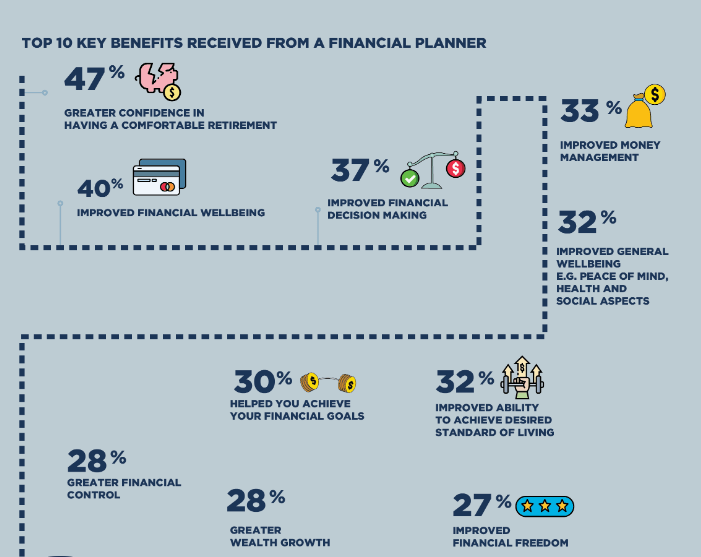
To celebrate Financial Planning Week 2022, the Financial Planning Association of Australia commissioned new research to highlight the difference in quality of life between Australians who have received financial advice from a Financial Adviser and those who have not received advice.

The research showed that Australians who received financial advice are significantly better off across the board compared to those who are not advised. Advised clients reported the following benefits of receiving advice:

  • Greater financial confidence
  • Improved financial decision making
  • Help achieving their financial goals
  • Improved money management
  • Greater peace of mind

We are proud to be Financial Advisers, working in a profession that aims to help our clients live well and enjoy financial freedom.

The infographic below captures the top 10 key benefits of receiving financial advice:

Source: Financial Planning Association of Australia

If you have been thinking about seeing a Financial Adviser, please get in touch with us so that we can show you how you too can benefit from receiving financial advice.

Shares sliding again?

You would be forgiven for asking if you can get off the rollercoaster that is the share market in 2022. Share markets locally and overseas have pulled back again over the past week. There is continued pressure due to inflation, rising interest rates & bond yields and the rising risk of recession. These factors could hurt company profits, hence the volatility we are seeing investment markets.

At times like this, Shane Oliver, Head of Investment Strategy & Chief Economist at AMP, reminds us that there are 7 key messages that investors should keep in mind:

  1. Share market pullbacks are healthy and normal – their volatility is the price we pay for the higher returns they provide over the long term;
  2. It’s very hard to time market moves so the key is to stick to an appropriate long-term investment strategy;
  3. Selling shares after a fall locks in a loss;
  4. Share pullbacks provide opportunities for investors to buy them more cheaply;
  5. Shares invariably bottom with maximum bearishness;
  6. Australian shares still offer an attractive income (or cash) flow relative to bank deposits; and
  7. To avoid getting thrown off a long-term strategy – it’s best to turn down the noise around all the negative news flow.

To read more on Shane’s thoughts: check out the latest addition of Oliver’s Insights

Investing: Asset Classes Animation

There is a lot of research, planning and thought that goes into building an investment portfolio that is right for you. We carefully consider:

Your current position

Your goals

Your investment timeframe

Your risk tolerance

Your investment preferences

This animated video explains the different asset classes that make up a portfolio. If you would like to discuss how we can help you build a customised investment portfolio, please contact us today.